
bodywork
What is in-depth bodywork, and how does MAJA differ from deep tissue massage?
A clear explanation of bodywork, deep tissue massage and MAJA, without promises of medical results.
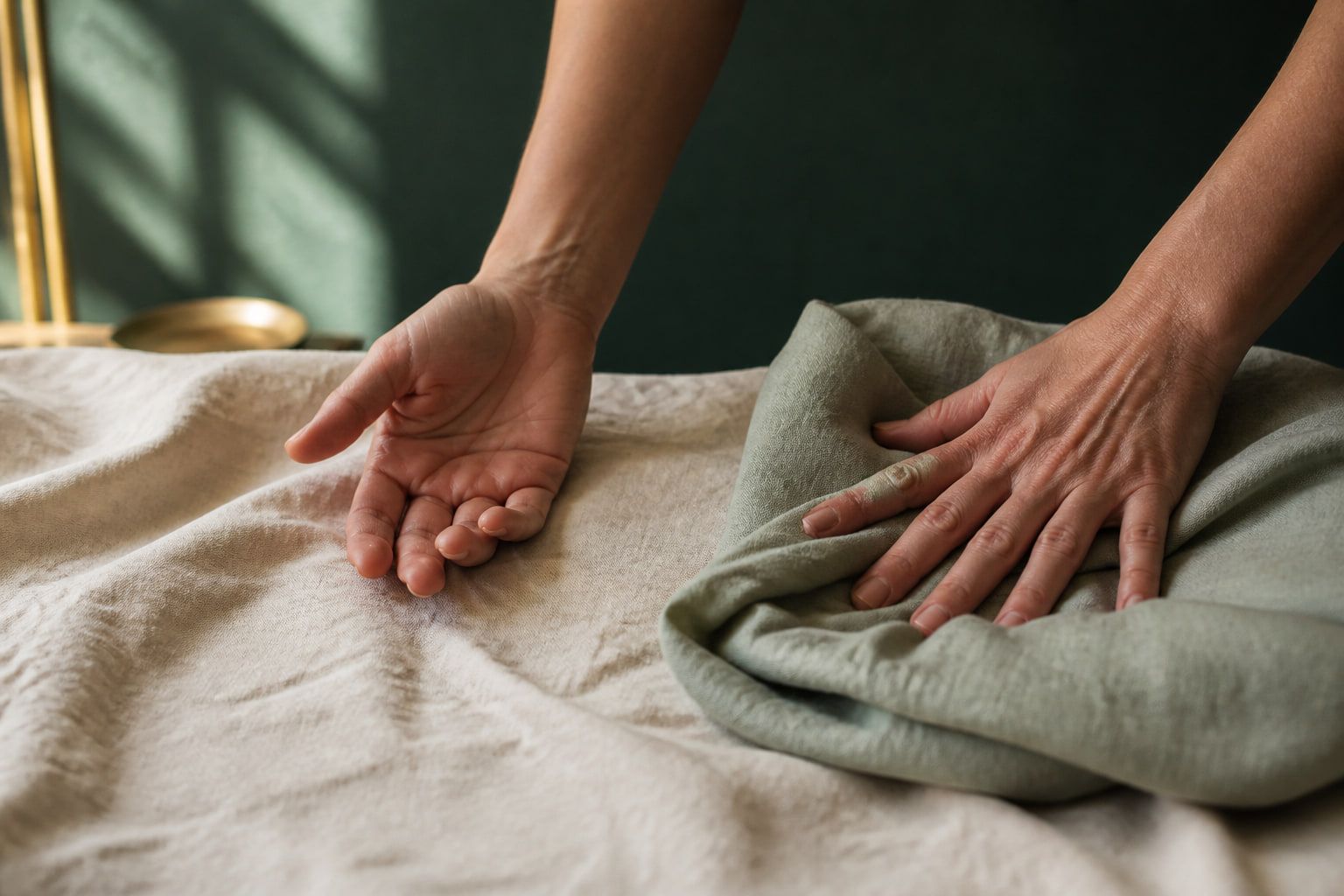
In-depth bodywork and deep tissue massage are not simply two names for the same service. Deep tissue massage generally means focused work on soft tissues, often using slow movements and firmer pressure. Bodywork is a broader term that often describes the nature of an experience. In this context, MAJA is a three-hour experience at a pace tailored to you. It is not a medical service or a substitute for diagnosis.
The word “deep” can easily suggest that physical force is what matters: the stronger the pressure, the deeper the work. Yet depth can also come from time, attention and a slower connection with your body. When choosing a session, it is worth asking more than what it is called. Ask what will actually happen, what the session is for and how your boundaries will be respected.
These terms are not interchangeable
International health resources define massage therapy as the use of various techniques to work on the body’s soft tissues. Even “deep tissue massage”, however, has no single universally accepted definition in scientific literature. Some use it to describe an intention to reach deeper layers of tissue; others mean a more specific set of techniques. This matters because the same name can refer to different levels of pressure, different paces and different approaches to a session.
In Lithuania, everyday language needs to be distinguished from the legal category of a service. Lithuanian medical standards classify the practice of a medical massage specialist as healthcare, subject to requirements for professional competence and licensing. Meanwhile, the National Public Health Centre (NVSC) discusses body-care massage, excluding medical massage, within the regulation of beauty services. The label “bodywork” or “body therapy” alone does not tell you which category a particular service belongs to. The provider should explain this clearly and accurately.
| Question | Deep tissue massage | The MAJA bodywork experience |
|---|---|---|
| What is the main focus? | Usually soft tissues and specific areas of the body | The whole experience: how you feel today, your boundaries, where you would like attention and a pace that suits you |
| What does “deep” mean? | Often slower, focused work, sometimes with firmer pressure | More time and closer attention, rather than a promise of stronger pressure |
| How does it begin? | This depends on the provider and the type of service | A short conversation about how you feel that day, your boundaries and where you would like attention |
| How long does it last? | The length is set out in the specific offer | Three hours |
| Is it a medical service? | The name alone does not establish this; check the provider’s stated service category and qualifications | No. MAJA does not replace diagnosis, treatment or healthcare |
| How is the intensity chosen? | It should be discussed and adjusted in response to your feedback | The pace and focus are agreed individually, with respect for your boundaries |
This comparison explains the differences without ranking one approach above the other. On a particular day, one person may want a clearly defined massage, while another may value a longer, unhurried bodywork experience. A good choice starts with understanding what you are looking for now, rather than a promise of “more”.

What deep tissue massage means in practice
Public descriptions of deep tissue massage generally refer to slow movements, focused pressure and attention to muscles and fascia. The strength of the pressure, however, is not a reliable measure of quality. Research reviews highlight considerable differences in how treatments are described. Findings from general massage research cannot therefore be assumed to apply to one particular technique or individual service.
The same caution matters when discussing effects. A 2024 systematic review found few conclusions supported by moderate-certainty evidence on massage and pain, and none supported by high-certainty evidence. Evidence that massage was more beneficial than other active interventions was also rare. This does not mean a person cannot experience a pleasant or meaningful change. It means that an honest description of a service should not promise a treatment outcome.
Depth should not be equated with pain, either. Discomfort is not a necessary sign that the work is “working”, and your boundaries are not an obstacle to the session. If you are unsure about intensity, you may find it helpful to read whether massage should hurt beforehand and agree on how you will ask for a change in pressure or a stop during the session.
With MAJA, depth comes from time and attention
MAJA is a three-hour Láurem experience created by Laura Kievlić. It begins with a short conversation about how you feel, your personal boundaries and where you would like more attention. The pace is then adapted to you. Its depth comes from the opportunity to take your time and be met as an individual, rather than from a predetermined promise of pressure.
This bodywork is not presented as medical massage. MAJA does not diagnose or treat illness, and it does not replace a consultation with a doctor or another healthcare professional. If you have a health condition that raises questions, speak to an appropriate professional first and share any relevant information before a bodywork session.
The way time is used is another difference. Sessions come in different lengths, but the number of minutes alone guarantees neither depth nor quality. It simply changes the pace that is possible. You can read more about what session length really affects in how long a massage lasts and how to choose a duration.
The MAJA experience is created by Laura Kievlić, while Láurem is the parent brand. This distinction keeps the description precise: MAJA is not a generic name for a deep tissue technique. It is a particular signature experience with a defined length and an opening conversation to agree on the session.
Bodywork or massage: choose according to what you want
If you want focused attention on a particular part of your body, ask about the approach, how pressure is chosen and what the proposed deep tissue massage actually involves. If you are looking for more time, a slower pace and an experience that takes you as a whole into account, the technique’s name may matter less than how the session unfolds, whether you can discuss your boundaries and how well the practitioner listens.
Before booking, three simple questions can help: how do you define this service, what happens at the beginning and how can I ask to change the intensity? Our guide to choosing a massage in Vilnius offers more points to consider. A name can help you begin your search, but a clear description, your needs and a shared understanding of boundaries should guide your decision.
It is also worth distinguishing a personal approach from a vague one. An individually tailored session can respond to the person, but you should still know beforehand what is and is not offered. An honest description should leave no uncertainty about the length, purpose, provider’s role or your right to state your boundaries at any time. If a description relies on big promises without explaining the process, ask for a more concrete answer.
Boundaries are not a box to tick at the start. How you feel can change during the experience, so agreeing earlier does not mean you have to continue at the same intensity. You can change your mind, ask for a pause or request attention elsewhere. This is especially relevant when a service uses words such as “deep”, “intense” or “relaxing”, because each person understands them differently.
It also helps to be clear about what you do not expect. If you are looking for a diagnosis, an assessment of a condition or a treatment plan, a non-medical experience is not an appropriate substitute. If you simply want to give your body more time without a promised result, that is a valid choice too. Clarity helps you approach the experience on your own terms without diminishing its personal nature.
Finally, there is no need to choose according to a supposed hierarchy of services. One approach is not more sophisticated or valuable than another. They have different intentions. The best fit is the one whose description matches what you want and whose provider helps you feel heard before you even meet.
Frequently asked questions
Is in-depth bodywork the same as deep tissue massage?
No. In-depth bodywork can be a broader description chosen by a provider for an experience, while deep tissue massage usually refers to work on soft tissues. Since even the latter term is defined differently in scientific literature, it is always worth reading what the particular service involves.
Does deep tissue massage have to use strong pressure?
Not necessarily. It is often associated with slow, focused pressure, but “deep” is not the same as the strongest possible pressure. Intensity should be agreed with you, and your request to reduce it is reason enough to do so.
How does MAJA differ from a typical massage session?
MAJA is defined as a three-hour experience that begins with a short conversation. Its pace and focus are adapted to how you feel, your boundaries and your wishes. It does not promise one particular technique or the same intensity for everyone.
Is MAJA a medical service or a form of medical massage?
No. MAJA is a non-medical experience and does not replace diagnosis, treatment or a professional consultation. If you are seeking help with a symptom or health condition, discuss the appropriate approach with a healthcare professional first.
Can I say which areas I would like more attention to before MAJA?
Yes. That is what the short opening conversation is for. You can describe how you feel, where you would like attention and your personal boundaries. Your ongoing feedback also matters throughout the experience.
How do I know whether bodywork or massage would suit me better?
Identify what you are looking for today: a massage focused on a particular area or a longer experience at a pace adapted to you. Then compare more than the names. Look at each service’s purpose, process, the provider’s qualifications and how intensity is discussed.
What should I do if I feel uncomfortable during a session?
Say so straight away. You can ask to change the pressure, pace or area of focus, or to stop. Clear boundaries are not impolite. They are an essential part of respecting your body and your choices.
Sources and further reading
- Lithuanian medical standard MN 165:2021, “Medical Massage Specialist”
- State Health Care Accreditation Agency: licensing for medical massage specialists
- NVSC: requirements for massage and body-care services
- NVSC: FAQs on hygiene permits
- Koren and Kalichman: a review of definitions of deep tissue massage
- Mak and colleagues: a 2024 systematic review of massage for pain
- US NCCIH: Massage Therapy: What You Need To Know
- Australia’s Better Health Channel: massage types and safety considerations
- Yin and colleagues: a systematic review of adverse events associated with massage
Discover MAJA at your own pace.
Laura personally confirms each booking for the three-hour bodywork session.
Write to Laura