
should a massage hurt
Should a massage hurt? Talking about pressure and discomfort
Pain is not a measure of massage quality. Clear feedback helps you protect your boundaries and feel comfortable with the touch you receive.
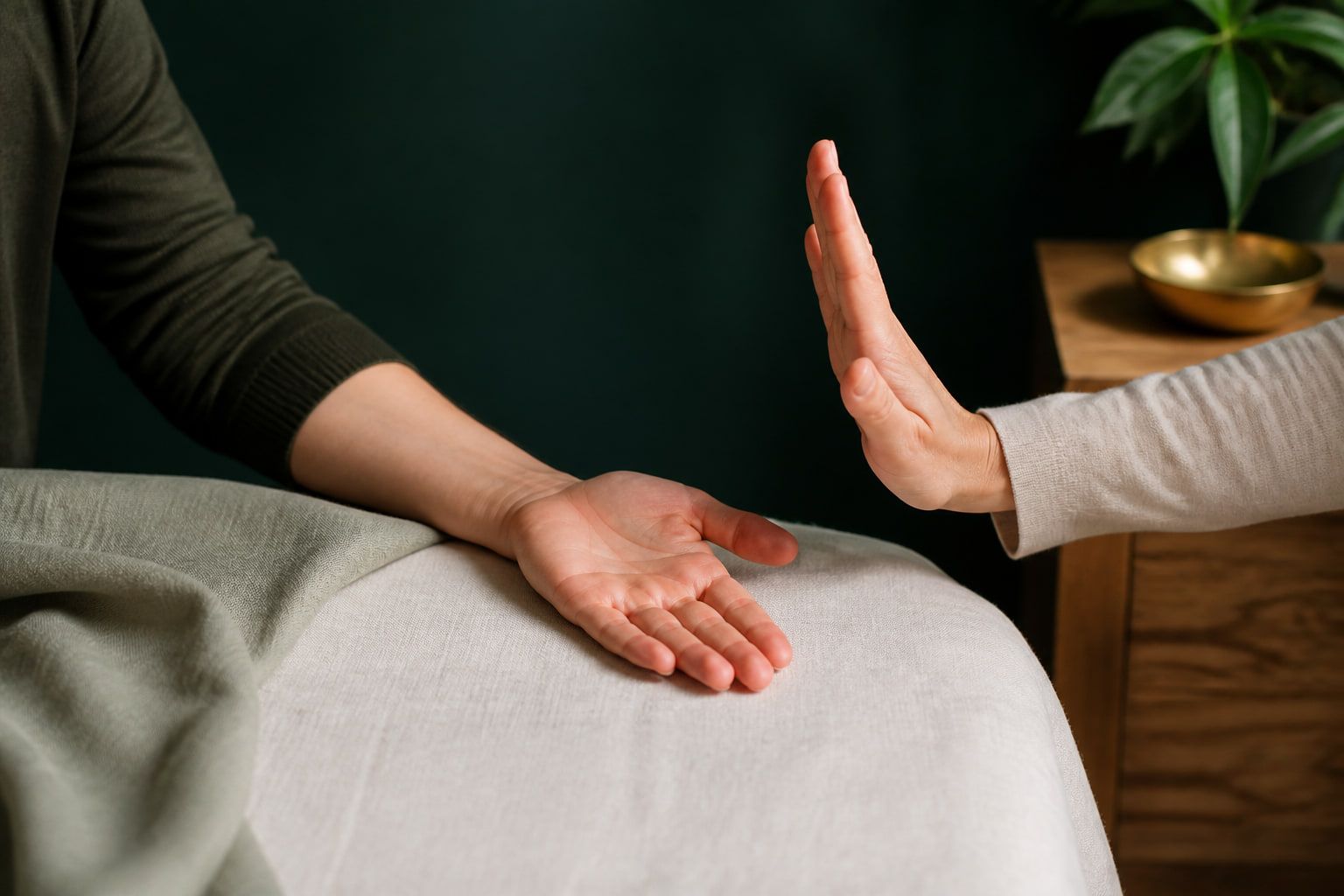
The short answer is no, a massage does not have to hurt to be worthwhile. Some people enjoy a firmer touch, and pressure on a sensitive area may briefly feel intense but comfortable enough to accept. Sharp, burning, spreading or increasingly severe pain, however, is never the aim of a massage, and you do not need to endure it. If you feel like pulling away, holding your breath or tensing up, that is reason enough to ask for less pressure, a pause or a complete stop.
The idea that a good massage has to hurt is often passed on as practical wisdom. Research does not support this rule. Massage studies cover very different techniques, durations and levels of pressure, and there is little high-certainty evidence about its effect on pain overall. There is even less reason to claim that more pressure leads to a better result.
An intense sensation is not necessarily harmful, but you do not have to prove that you are in pain
Pain is a personal experience. The International Association for the Study of Pain emphasises that biological, psychological and social factors all influence it, and that a person’s account of their pain should be respected. The same touch may feel gentle to one person, firm to another and painful to someone else. None of these responses is “wrong”.
Rather than looking for a universal pain threshold, it can help to distinguish between different kinds of sensation:
| Sensation | What it might feel like | What you can do |
|---|---|---|
| Comfortable pressure | Definite and firm, while allowing you to breathe easily and stay present | Continue and notice whether the sensation changes |
| Discomfort approaching your limit | You want to tense up, pull away or hold your breath | Ask for less pressure straight away, change the area or your position, and talk it through |
| Pain or a warning sign | Sharpness, burning, tingling, a spreading sensation, numbness or sudden weakness in a limb | Ask the practitioner to stop; seek advice from a healthcare professional if the symptom is acute, severe or unexplained |
This table is not a diagnostic tool. It simply offers words for what you are feeling. Even “good pain” is not permission to carry on automatically. A sensation can change in seconds, so consent and the level of pressure you choose can change too.
Why “you need to put up with it” is misleading
Recent reviews show that evidence for the effects of massage on painful conditions is mostly of low or very low certainty. A 2024 systematic review found no high-certainty conclusions and only a few of moderate certainty. In a Cochrane review of neck pain, massage offered little or uncertain benefit over a sham procedure, and adverse events were not adequately reported in the studies.
This does not make a person’s pleasant or meaningful experience any less real. It does mean that a particular outcome cannot honestly be promised, or painful pressure presented as scientifically necessary. Studies define massage in different ways, and often do not even describe the pressure precisely. In practice, firmer pressure is a preference, not a measure of quality.
There is also an important distinction between feeling pain and having tissue damage. A sensation alone cannot tell you what is happening in the body, but pain should not be dismissed simply because nothing is visible from the outside. “Should a massage hurt?” should never become a test of how much someone can tolerate. A more useful question is: “Am I comfortable with this touch right now?”
Massage pressure is a conversation, not just a number
A scale from 0 to 10 can help, but it is not essential. One person’s “six” is pleasantly firm; another person’s is already their limit. Sometimes describing your body’s response is clearer than giving a number: I can breathe freely, I am starting to brace myself, I want to move away, the sensation is spreading.
You can keep it very simple:
“That’s too much pressure here. Please go more gently.”
“This pressure is fine, but I don’t want it any stronger.”
“That feels sharp, and it’s spreading. Let’s stop.”
“I’m finding it hard to tell right now. Can we pause and talk?”
“I’d rather leave that area alone today.”
The right response is action, not persuasion to put up with it: the practitioner stops, eases the pressure, moves to a different area or ends the session. The standards set by Ontario’s regulator for massage therapists state that consent must be maintained throughout a session, and that a person can ask for an action to be changed or stopped at any time. This is a rule for a specific regulated healthcare profession in Canada, not a legal standard for Lithuania or for every form of bodywork. It nevertheless expresses a clear principle of respectful practice.
For more ways to prepare, read about the conversation before a personalised massage. We discuss clothing and freedom of choice separately in do you need to undress for a massage?.
Discomfort after a massage: what to notice
Mild, short-lived tenderness or aching can occur after some massages. However, studies report unwanted effects inconsistently, so there is no reliable universal rule for how long discomfort “should” last or how strong it should be. Australia’s public health information service lists mild pain or tenderness as a possible side effect and advises seeing a doctor if the pain does not settle quickly.
What matters most is whether it is getting better or worse. Mild tenderness that eases and does not interfere with everyday activities is different from worsening pain, significant swelling, a large bruise or new changes in sensation or strength. Do not try to have a severe symptom “massaged out” again. Tell the practitioner what happened, and seek a health assessment from a qualified healthcare professional.
When to stop, and when to seek medical assessment
Touch should stop immediately if pain is sharp, burning or spreading, or if numbness, tingling, weakness, dizziness or nausea develops. It should also stop if the person simply no longer wants to continue. You do not need a symptom to stop. “I don’t want to” is reason enough.
Urgent medical assessment is needed for severe or rapidly worsening pain, pronounced new weakness or loss of sensation, shortness of breath, chest pain, fainting, significant swelling or a suspected injury. If pain or another unexplained symptom persists, interferes with daily life or worries you, speak to a doctor or another healthcare professional qualified to assess the situation. Massage and bodywork should not delay medical advice that you need.
In Lithuania, medical massage is a regulated area of healthcare. The professional standard for medical massage specialists covers assessing a patient’s condition, choosing safe techniques and recognising life-threatening conditions. Separately, the National Public Health Centre applies public health safety requirements to massage services provided as body care. These are different settings, so the service name alone is not enough: it also matters who provides it, what it is intended for and where the practitioner’s expertise ends.
How we approach this in a MAJA session
MAJA is a three-hour experiential, non-medical bodywork session with Laura Kievlić. It begins with a conversation and responds to how you feel and to your boundaries. MAJA is not pain treatment, a diagnostic service or a promise of a particular result.
Here, “should a massage hurt?” gives way to a more attentive question: what do you need for this touch to feel comfortable right now? The answer can change during the session. You can ask for a gentler or firmer touch, a slower pace, a stop, or for a particular area to be left alone. Conversation is part of the experience.
If you are comparing different approaches to touch, our article on bodywork and deep tissue massage may help. The essential distinction in this conversation is not the label. It is having a clear understanding of expectations, boundaries and the practitioner’s scope of practice.
Frequently asked questions
1. Does a massage have to hurt to “work”?
No. Research does not show that pain during massage is necessary for it to be effective, or that more pressure always produces a better result. An intense but acceptable sensation can be a personal preference, but you do not need to endure it for the sake of a promised benefit.
2. Is a little discomfort in a sensitive area normal?
Brief, manageable tenderness can occur, but “normal” is not the same for everyone. If you pull away, hold your breath or feel a sharp sensation, ask for less pressure or a stop. Your description is enough, even if someone else would experience the same touch differently.
3. How do I ask for less pressure without offending the practitioner?
Say it directly: “Please go more gently” or “That’s too much pressure here”. You do not need to apologise or give a long explanation. Responding to feedback is part of respectful practice.
4. When should a massage stop immediately?
Stop if the sensation is sharp, burning or spreading, or if you develop numbness, tingling, weakness, dizziness or feel unwell. You can also stop whenever you no longer want to continue, even if you cannot explain exactly why. A healthcare professional should assess acute or severe symptoms and the care they require.
5. How long can discomfort after a massage last?
Mild, short-lived tenderness can occur, but the research does not offer one reliable rule that applies to every massage and every person. Notice whether the sensation is clearly easing and whether you can carry on with your usual activities. If pain is severe, gets worse or does not settle quickly, seek medical advice.
6. When should I see a doctor after a massage?
Seek advice if pain is severe or increasing, or if significant swelling, a large bruise, new numbness, weakness or another unexplained symptom develops. Shortness of breath, chest pain, fainting or a sudden, marked neurological change requires urgent medical care. This article cannot establish the cause of a symptom.
7. Can we agree on the pressure beforehand?
Yes. It helps to describe what has felt comfortable in the past and which areas you do not want touched. That agreement can still change, because the same pressure may feel different on different parts of the body. You can revise it at any moment.
8. Is MAJA intended to treat pain?
No. MAJA is a three-hour experiential, non-medical bodywork session that begins with a conversation and respects how you feel and your boundaries. Acute, severe, persistent or unexplained pain needs assessment by a qualified healthcare professional.
Sources and further reading
- Lithuanian medical standard MN 165:2021, “Medical Massage Specialist”, e-TAR
- National Public Health Centre: safety requirements for face and body care services
- NCCIH: Massage Therapy, What You Need To Know
- International Association for the Study of Pain: revised definition of pain
- College of Massage Therapists of Ontario: Consent Standard
- Mak S. et al. Use of Massage Therapy for Pain, 2018–2023: A Systematic Review, JAMA Network Open, 2024
- Gross A. R. et al. Massage for neck pain, Cochrane Database of Systematic Reviews, 2024
- Yin P. et al. Adverse Events of Massage Therapy in Pain-Related Conditions: A Systematic Review, 2014
- Healthdirect Australia: Massage therapy guide
- Mayo Clinic Press: What to expect during a massage therapist visit
Discover MAJA at your own pace.
Laura personally confirms each booking for the three-hour bodywork session.
Write to Laura